

At Paintzone, we brush limewash by hand onto interior walls and onto brick and stone outside, for a soft, cloudy matte finish with gentle shifts in color.
Working with Paintzone
Owner-run
Paintzone is owned and run by Andrei Danu and Dorin Sirbu, who came to painting from architecture and mural work.
Specialty finishes in house
Limewash, Roman clay and tadelakt can go on the same estimate as the paint, from one accent wall to a whole room.
Free written estimates
Every estimate is free and written out, listing the surfaces, the preparation, the products and the price.
What limewash is
Limewash is a lime-based paint that, over the years, wears to a soft patina instead of forming a film that peels.
The limewashes we use
Indoors we mostly use Portola Lime Wash, which its maker recommends for drywall, plaster and masonry, and we switch to another maker when a wall or a look calls for it. On brick and stone outside, we use Romabio Classico.
Where limewash works
Limewash works on bare, unsealed brick and stone as they are, and on drywall, painted walls, stucco and glazed brick once a primer is on. Bare masonry soaks the limewash up, while those other surfaces need the maker's primer to give it something to grip.
Living rooms, bedrooms and hallways
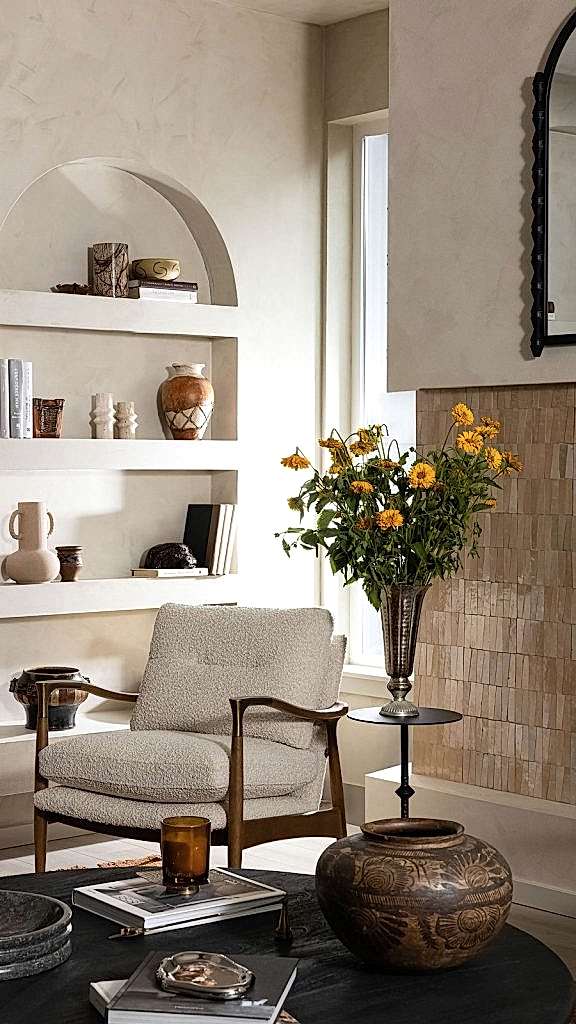
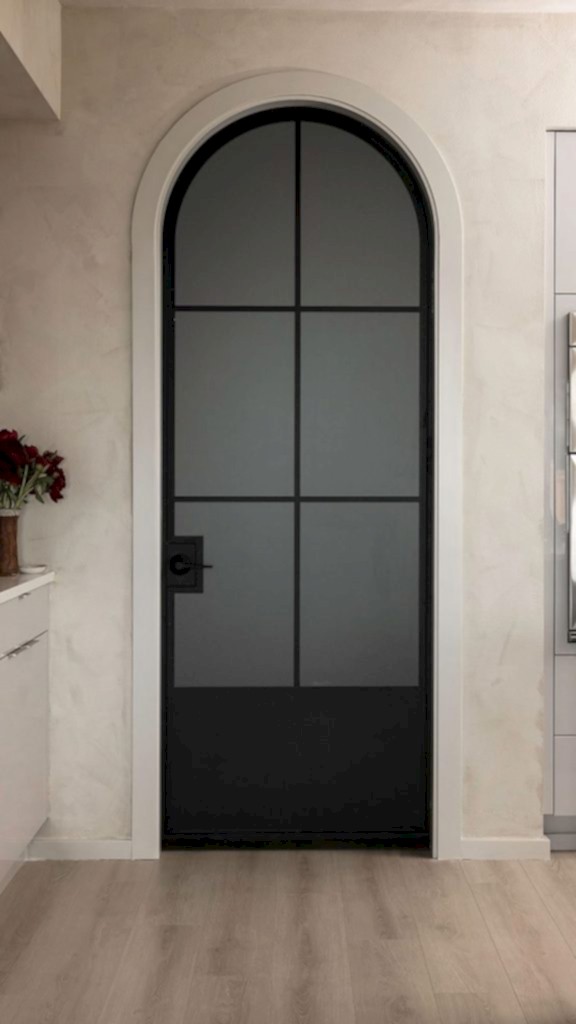
On interior walls limewash adds depth without adding texture, so one continuous coat can carry across walls, arches and built-in shelves, though it shows any texture already in the wall.
Brick and stone outside
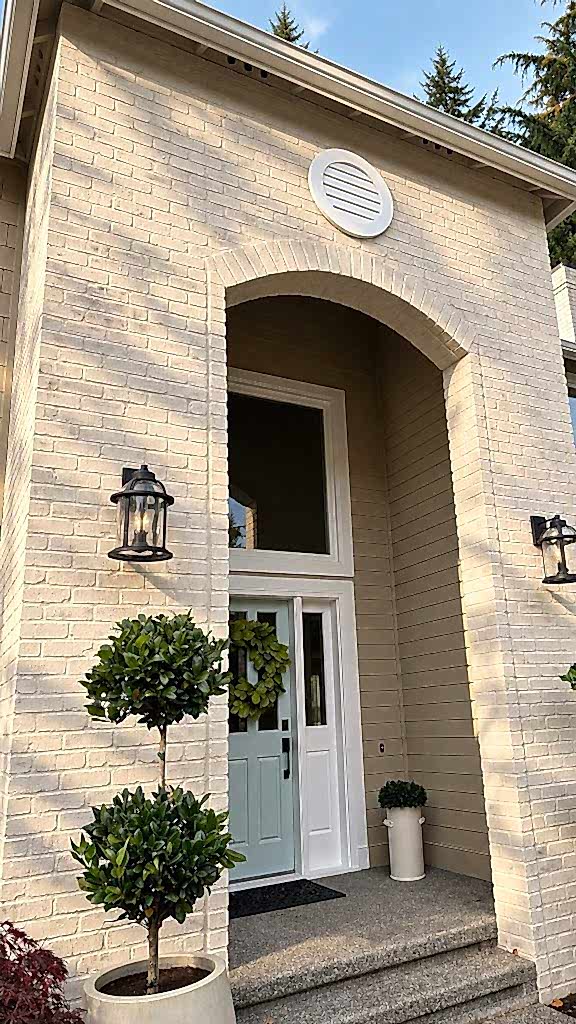
Outside, limewash suits unpainted brick and stone because it soaks into the masonry instead of forming a coat on top, and Romabio, its maker, states it will not chip, peel or flake off.
Where it does not belong
Limewash stays off floors, steps, patios and other flat surfaces where water sits, and off wood, metal and tile. Kitchen backsplashes need a different finish, because even Portola's sealer does not keep grease from staining limewash.
How we apply limewash
Limewash is unforgiving of stops and touch-ups, so each wall is brushed from edge to edge in one session. On a tall wall that can mean scaffolding.
Prepare and prime
We repair the wall and apply the primer the surface calls for. New drywall gets a stain-blocking primer before the limewash undercoat.
First coat
The first coat goes on with a wide brush in overlapping, crisscross strokes, and we keep the leading edge wet so no lap lines show.
Second coat
A second coat evens out the color and builds the movement. Limewash dries about four shades lighter than it looks wet, so we judge the color once it is dry.
Seal where needed
In kitchens, hallways and bathrooms we can add Portola's matte sealer. It suits light and light-medium colors, because it can leave a milky cast on dark ones.
Living with a limewashed wall
Unsealed limewash is a delicate surface that should not be wiped, so it suits walls that people look at more than touch. Where hands and bags brush past, the sealer lets you clean it with a barely damp cloth and mild soap.
Touch-ups and repairs
A small mark is hard to touch up invisibly, because fresh limewash shows lighter where it overlaps a dry coat. A larger repair can mean recoating the whole wall.
Limewash or Roman clay
Both are mineral finishes with soft movement. Limewash is brushed, stays flat and can go outside on masonry. Roman clay is troweled on as a thin plaster, feels velvety, can take a slight sheen, and is made for smooth interior walls only.
What affects the price of limewash
The surface and the primer it needs affect the price most, along with the size and height of the walls, whether a sealer goes on, and how much repair comes first. We price each job after seeing the walls.


Limewash FAQs
What is the difference between limewash and paint?
Paint dries as a film on top of the surface, while limewash soaks into masonry and stays flat and mottled, lightening with age instead of peeling. Unsealed, it cannot be wiped clean.
Can you limewash over painted walls?
Yes, with a primer. Portola calls for its Limeproof Undercoat on previously painted walls, and it goes on before the first coat of limewash.
Can you limewash brick?
Yes, painted or not. Bare brick soaks up the limewash with no primer, and painted or glazed brick gets Romabio's bonding primer first so the limewash has something to grip. A thinned coat lets some of the brick's own color show through.
Can limewash be used outside in Seattle?
Yes, on brick, stone and other masonry, on dry, mild days. Romabio asks for 50 to 88 degrees F and no frost on the nights after it goes on.
Can limewash go in a bathroom?
Yes, on the walls outside the shower, with Portola's sealer so they can be wiped. Inside the shower itself, tadelakt is the finish made for water.
How do I get a limewash estimate?
Get in touch at (206) 899-5154 or through the estimate form. We look at the surface in person and then send a written estimate.
Painting Across Seattle & the Eastside
Paintzone works in Seattle and across the Eastside, in Bellevue, Clyde Hill, Kirkland, Magnolia, Medina, Mercer Island, Newcastle, Queen Anne, Redmond, Renton and Sammamish.
To get started, request a painting quote or call (206) 899-5154. We are at 600 W Olympic Pl #503, Seattle, WA 98119.