

Roman clay gives an interior or feature wall a soft, marble-like matte surface, and at Paintzone we trowel it on by hand in thin layers of Portola Roman Clay.
Working with Paintzone
Owner-run
Paintzone is owned and run by Andrei Danu and Dorin Sirbu, who came to painting from architecture and mural work.
Specialty finishes in house
Limewash, Roman clay and tadelakt can go on the same estimate as the paint, from one accent wall to a whole room.
Free written estimates
Every estimate is free and written out, listing the surfaces, the preparation, the products and the price.
What Roman clay is
Roman clay is a cross between paint and plaster for smooth interior walls, as Portola, its maker, describes it. It feels smooth to the touch and shows soft, marble-like clouding, and left unsealed, it dries very matte.
Light or dark colors
Lighter colors show subtle movement, while darker ones show much more variation from the knife work. Its earthy undertone means some bright whites are out of reach, according to the maker.
Where Roman clay works
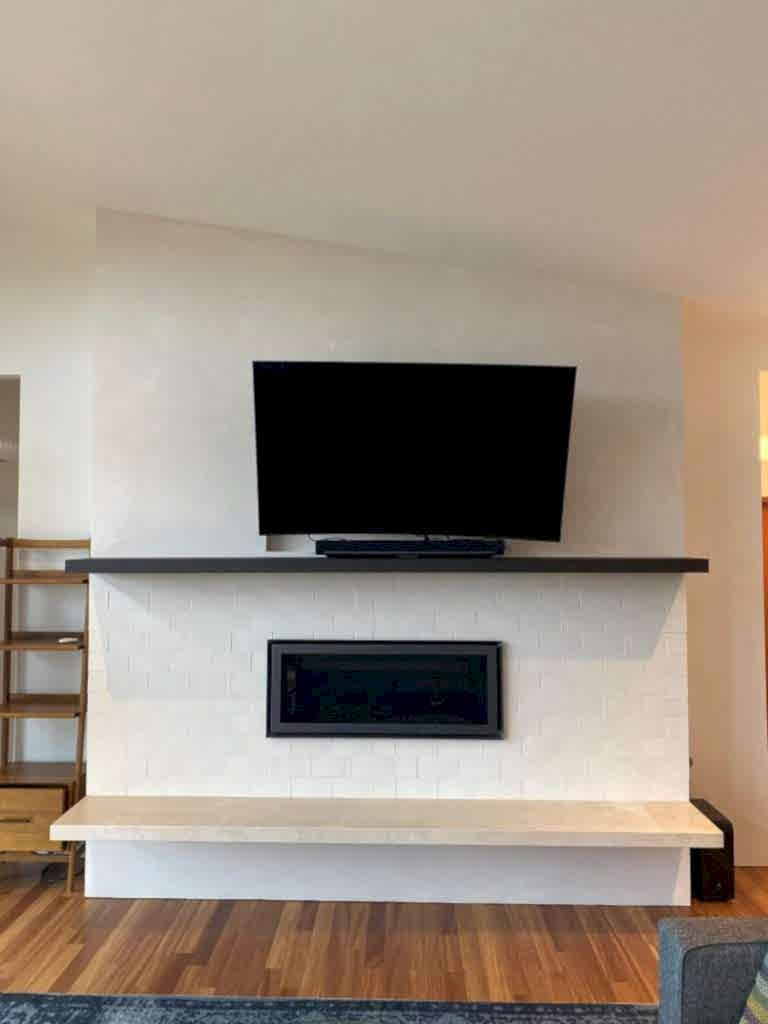
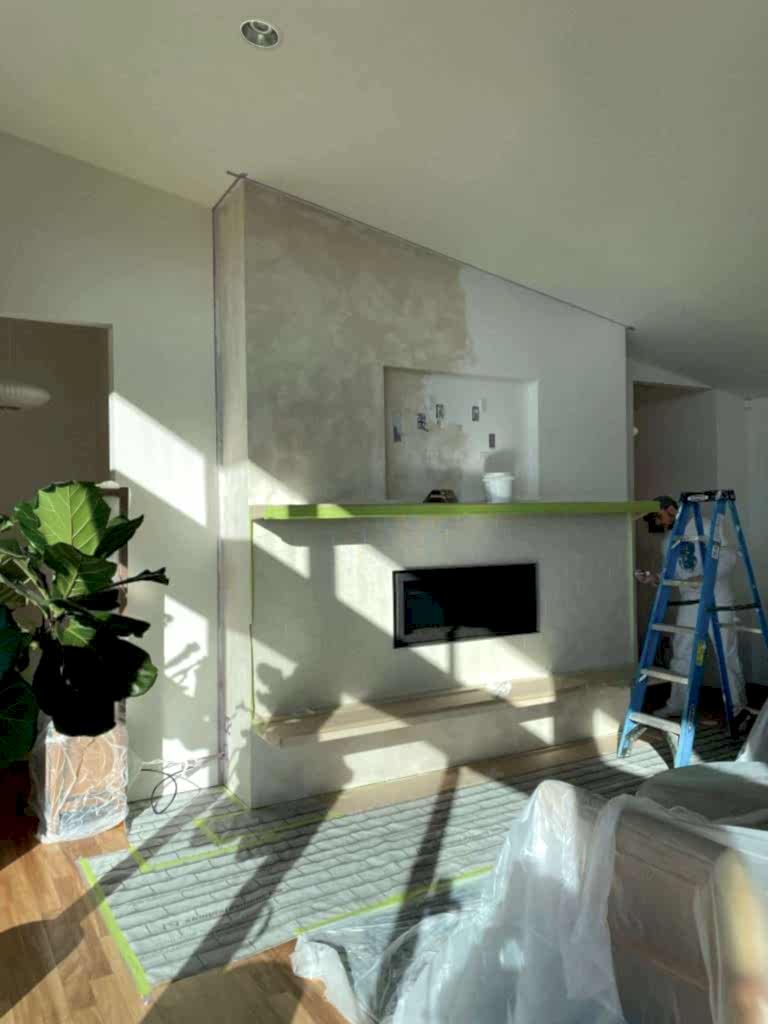
Roman clay works on smooth interior walls, from a fireplace surround or an accent wall to a whole room, and Portola recommends drywall finished to level 5, the smoothest grade.
Textured walls
A textured wall has to be smoothed before Roman clay goes on. The clay is laid in thin coats that do not fill imperfections, so an orange peel or knockdown texture would show through the finish.
Painted walls
Painted walls usually get a stain-blocking primer first. A wall in ultra flat paint that is in good condition and close in color to the clay can often skip that step.
Columns and curves
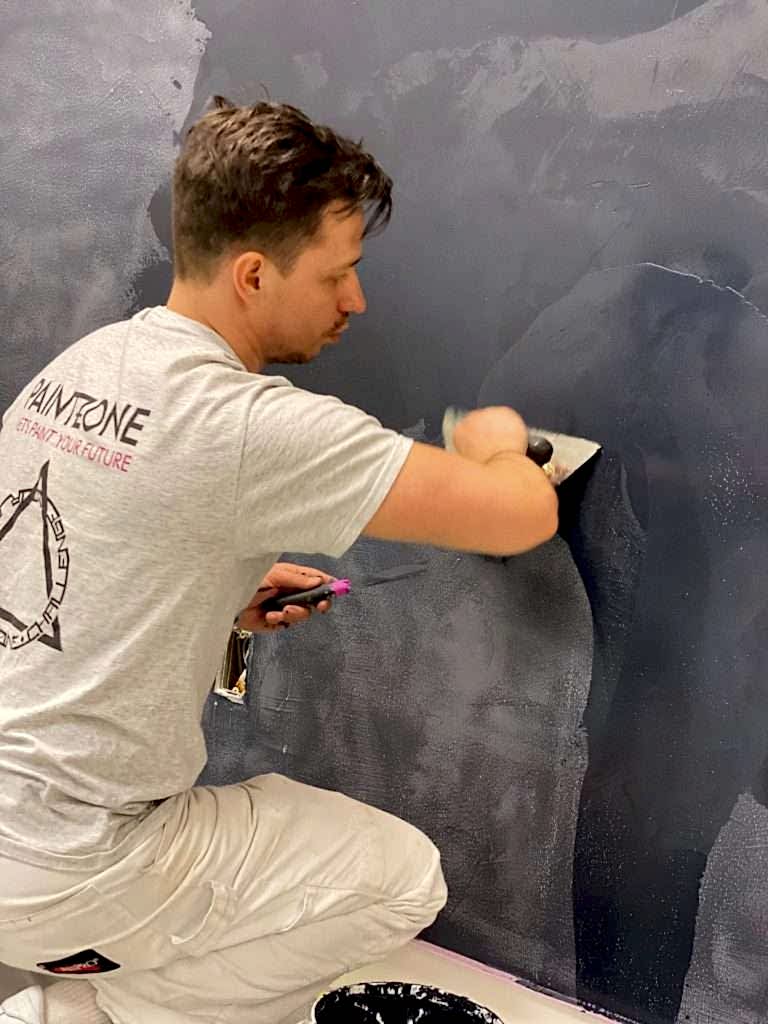
A flexible knife carries Roman clay around columns and curves, so the finish runs on without a break.
How we apply Roman clay
Roman clay goes on with a putty knife or trowel in two thin, overlapping coats, and the knife work is what builds the movement.
Prepare and prime
We smooth the wall and roll on a water-based primer, with a stain-blocking primer on new drywall.
Base coat
The first coat goes on thin and tight with a flexible knife, covering most but not all of the primer.
Light sanding
Once it is dry, high or rough spots are sanded smooth with fine sandpaper.
Final coat
A second thin coat evens the color and brings out the marble-like movement.
Living with Roman clay
A barely damp rag cleans Roman clay, sealed or not, and on a sealed wall a soft sponge with mild, dye-free dish soap is fine. Portola notes that the finish can be more delicate than regular paint.
Scuffs and touch-ups
Scuffs on an unsealed wall can usually be buffed out with very fine sandpaper. Touch-ups are possible but tricky to make seamless, according to Portola.
Roman clay or Venetian plaster
Venetian plaster is built from thin layers of limestone or marble and burnished to a hard, stone-like surface. Roman clay has a softer, more subtle look and a velvety feel. For a brushed, flat mineral look, compare limewash.
What affects the price of Roman clay
The condition of the wall affects the price of Roman clay most, and then the size and height of the area, any curves and columns, and whether a sealer goes on. Each estimate follows a look at the walls.


Roman clay FAQs
Does Roman clay need to be sealed?
Only in high-traffic areas, where Portola recommends its Topcoat. It adds an eggshell-level sheen and deepens the color, and it does not make the finish waterproof.
Can Roman clay go in a bathroom or kitchen?
On walls away from direct water, yes. Portola rules out wet areas such as the inside of a shower, and its Topcoat is not meant for backsplashes where grease and water land.
Can Roman clay be used outside?
Roman clay is made for interior walls only, so Portola rules out exterior use.
How durable is Roman clay?
It is more delicate than regular paint, according to Portola. Sealing helps in hallways and other high-traffic spots, and a scuff on an unsealed wall can usually be buffed out.
What is the difference between Roman clay and limewash?
Roman clay goes on with a trowel or putty knife as a thin plaster and feels smooth and velvety. Limewash is brushed on, stays flat and chalky, and can also go outside on brick and stone.
How do I get a Roman clay estimate?
Ring (206) 899-5154, or tell us about the walls through the estimate form. We look at them in person and send a written estimate.
Painting Across Seattle & the Eastside
Paintzone works in Seattle and across the Eastside, in Bellevue, Clyde Hill, Kirkland, Magnolia, Medina, Mercer Island, Newcastle, Queen Anne, Redmond, Renton and Sammamish.
To get started, request a painting quote or call (206) 899-5154. We are at 600 W Olympic Pl #503, Seattle, WA 98119.